// Article 02 · Uncle Spore
What Actually Is a Mushroom?
In this article
Before We Grow One, We Should Probably Know What It Is
Right.
We've decided we're going to grow mushrooms.
Before we start injecting things into bags and pressure cooking cereal grains, it might be useful to establish exactly what we're trying to grow.
Because a mushroom isn't a plant.
It isn't an animal either.
And, technically speaking, the mushroom isn't even the whole organism.
We've therefore managed to get two paragraphs into the science and already nothing is behaving itself.
Welcome to mycology.
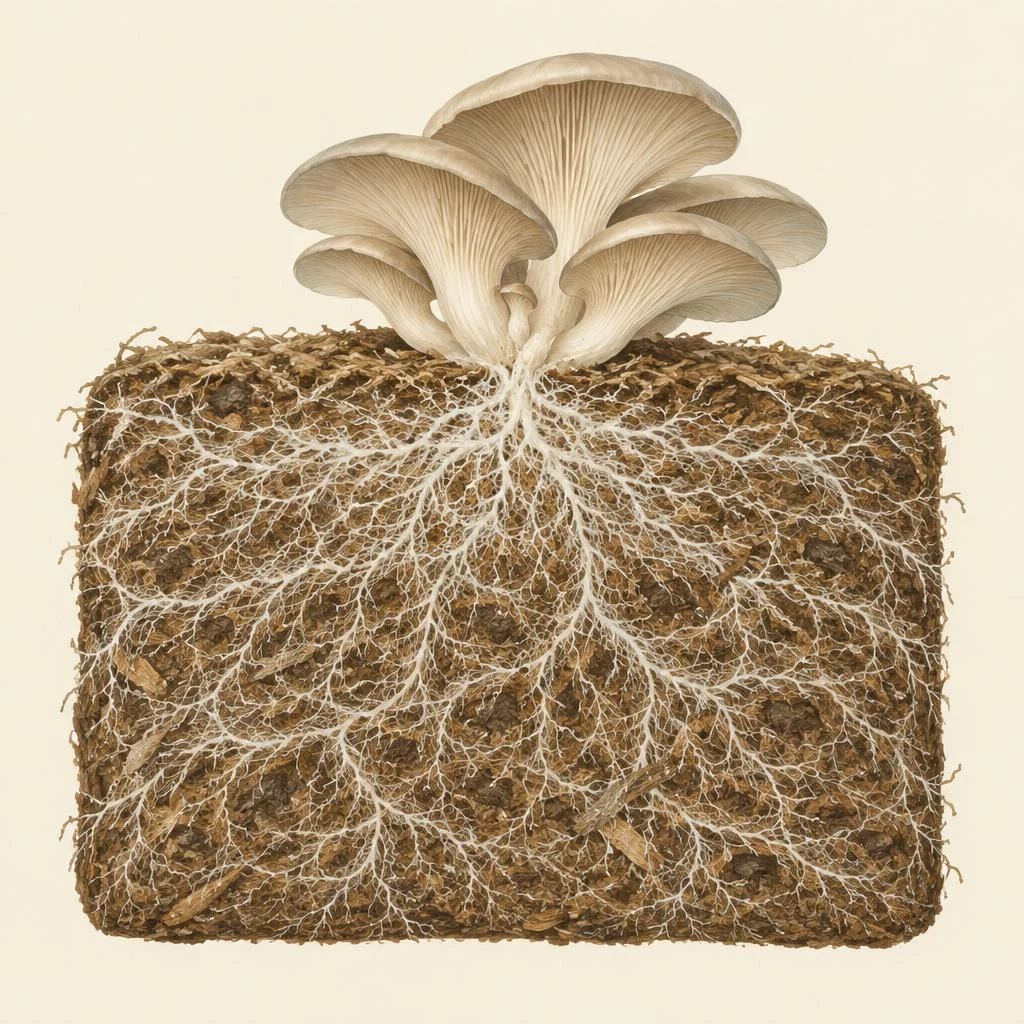
- Mushroom
- Visible fruiting body
- Mycelium
- The branching network
- Hyphae
- Individual fungal threads
- Substrate
- The material it grows through
- Spores
- Colonisation
- Fruiting
Fungi Aren’t Plants
For a long time, fungi were classified alongside plants.
It's understandable.
They don't generally run about.
They grow out of the ground.
Some have stems.
And asking one what it is tends to produce very little useful information.
But fungi are fundamentally different from plants.
They belong to their own biological kingdom: Fungi.
Plants generally capture energy from sunlight through photosynthesis.
Fungi don't.
They don't contain chlorophyll and they cannot sit in the sunshine making sugars for themselves.
Instead, fungi obtain nutrients from the material around them. They release enzymes into their environment, break suitable material down externally, and then absorb the resulting nutrients.
Think about the difference this way.
You eat your dinner and digest it inside your body.
A fungus effectively pours the digestive chemicals onto dinner first and then absorbs what's left.
Which sounds revolting until you remember we're the species that invented Pot Noodles.
You’re More Closely Related to a Mushroom Than a Mushroom Is to a Plant
Here's a good one for your next uncomfortable family gathering.
From an evolutionary perspective, fungi and animals are more closely related to one another than either is to plants.
We're not saying your Uncle Barry is an oyster mushroom.
Although further testing may be warranted.
Animals and fungi belong to neighbouring branches of the evolutionary tree and share a common ancestor deep in evolutionary history. Fungi are an ancient lineage stretching back roughly a billion years or more, while many familiar mushroom-forming fungi belong to groups with evolutionary histories measured in hundreds of millions of years.
So mushrooms weren't recently invented by vegan restaurants in Shoreditch.
They've been at this for quite some time.
Fungi Have Some Surprisingly Animal-Like Features
There are other interesting similarities.
Plants typically store reserve carbohydrate as starch.
Fungi, like animals, store carbohydrate predominantly as glycogen.
Plant cell walls are largely made from cellulose.
Fungal cell walls contain chitin — the tough structural material also found in the exoskeletons of insects and crustaceans.
And the mushroom-forming fungi we're going to cultivate use oxygen for respiration.
So when growers talk later about fresh air exchange, they're not simply trying to make the mushrooms comfortable.
Actively growing fungi respire.
They consume oxygen and release carbon dioxide as part of their metabolism.
They don't have lungs.
You don't need to give them CPR.
But gas exchange matters.
Quite a lot, as we'll discover when we get to fruiting.
Not a plant
No photosynthesis
External digestion
Enzymes break material down outside the fungus
Uses oxygen
Oxygen in · carbon dioxide out
The Mushroom Isn’t Really “The Fungus”
This is probably the most important concept in this article.
When somebody points at an oyster mushroom and says:
“That's the fungus.”
they're only seeing part of it.
The familiar mushroom is a fruiting body: a reproductive structure produced by the fungus.
The main vegetative body consists of extremely fine strands called hyphae.
Collectively, a network of hyphae is called mycelium.
If you've ever pulled apart a piece of decaying wood and found white thread-like growth running through it, there's a reasonable chance you've been looking at fungal mycelium.
In cultivation, you'll become extremely familiar with it.
You'll spend weeks enthusiastically watching white stuff grow through bags.
Your previous hobbies will begin to seem strangely exciting.
Think Apple Tree, Not Apple
A useful — although imperfect — analogy is an apple tree.
The apple isn't the whole organism.
The tree exists before the apple appears.
Under appropriate conditions, the tree produces fruit containing structures involved in reproduction.
Similarly, the fungus can exist as an established mycelial network long before a mushroom appears.
When conditions are suitable, certain fungi produce mushrooms.
Those mushrooms help the fungus reproduce and disperse.
So:
Mycelium = the established fungal body we're cultivating.
Mushroom = the reproductive fruiting structure we're eventually trying to produce.
This distinction matters enormously.
Because during much of mushroom cultivation, we aren't actually growing mushrooms yet.
We're growing mycelium.
The mushrooms come later.
Fungus ≠ just the mushroom
Spores: Fungal Seeds That Aren’t Seeds
Mushrooms commonly reproduce using microscopic structures called spores.
You'll often hear these compared with plant seeds.
That's useful for explaining the general idea, but biologically they're very different things.
A seed is a multicellular structure containing a plant embryo and stored resources.
A fungal spore is much simpler.
Under appropriate conditions, a suitable spore can germinate and produce microscopic fungal filaments called hyphae.
Those hyphae extend and branch.
They form mycelium.
With mushroom-forming species that reproduce sexually, compatible fungal cells or mycelia must ultimately combine in the appropriate way before a mycelium capable of producing the familiar fruiting bodies is established.
Don't worry.
You won't be tested on this.
And for our beginner cultivation method, we're going to make life considerably easier by starting with established genetics rather than trying to begin every grow from spores.
We'll cover that properly when we discuss spores, agar and liquid culture.
What Does Mycelium Actually Do?
Mycelium explores its environment.
Hyphae extend through suitable organic material and secrete enzymes that break complex material into smaller compounds the fungus can absorb.
This is one reason fungi are so important ecologically.
Many species are extraordinarily effective decomposers.
They help break down dead organic matter and recycle nutrients through ecosystems. Fungi also form hugely important relationships with plants and other organisms.
For cultivation, however, we can simplify matters.
We're essentially going to give our chosen fungus:
food + water + the correct environment + enough time
and encourage its mycelium to occupy that food before anything undesirable does.
That last bit is where most of our problems begin.
Because unfortunately bacteria and mould also enjoy free accommodation and dinner.
Hence all the sterilisation we'll be talking about later.
Colonisation: Taking Possession of the Food
You'll hear the word colonisation constantly in mushroom cultivation.
It simply describes the fungus growing through and occupying a material.
Take a bag of sterilised grain.
We introduce our mushroom culture.
The mycelium begins growing.
It spreads from grain to grain.
Gradually, more of the bag becomes covered with healthy mycelium.
Eventually, under good conditions, the available grain becomes extensively colonised.
That colonised grain is commonly called grain spawn.
We can then use the grain spawn to introduce vigorous mycelium into a larger amount of suitable substrate.
That substrate might be based on materials such as straw or hardwood-derived material depending on the mushroom species we're cultivating.
The mycelium then colonises that.
At this point we have produced precisely zero mushrooms.
Don't panic.
We're building the organism first.
Fruiting: Why Does a Mushroom Suddenly Appear?
Once the fungus has colonised an appropriate substrate, changes in its environment can contribute to fruiting.
Exactly what conditions matter varies between species.
Temperature can matter.
Humidity matters.
Light can provide developmental cues for many cultivated species.
Fresh air and carbon-dioxide levels can matter enormously.
Available moisture matters.
The physiological state of the mycelium matters.
There isn't one universal button marked:
MUSHROOMS — ON
which is inconsiderate of them.
Different fungi have evolved to fruit under different environmental conditions.
Our job as cultivators is to understand the species we're growing and provide suitable conditions.
Once fruiting begins, tiny structures can develop into what growers commonly call pins or primordia.
Those develop into recognisable mushrooms.
The mushrooms mature.
They produce spores.
And biologically speaking, the fungus has achieved what it was trying to do all along.
We merely stole the fruiting bodies before it finished.
The Three Stages We’re Going to Use
The true fungal life cycle is more complicated than this, but for a beginner grower I want you to start with a much simpler mental model.
Stage One: Genetics
Spores → culture → established mycelium
This is where the fungus comes from.
Spores can germinate and establish new fungal growth, but growers can also work with existing living cultures.
In our beginner method, we'll largely remove the genetic lottery at the start by obtaining a good-quality established culture.
Later, we'll discuss spores, agar, liquid culture, cloning and culture propagation properly.
For now just remember:
We need healthy mushroom genetics to begin with.
Stage Two: Colonisation
Culture → grain → substrate
Now we're increasing the amount of mycelium.
We introduce our culture to prepared grain.
The fungus colonises the grain.
That grain becomes spawn.
We introduce the spawn to a suitable bulk substrate.
The fungus colonises that too.
This part is mainly about allowing the fungus to establish itself while keeping competitors out.
Which sounds easy.
It is easy.
Until you meet mould.
Stage Three: Fruiting
Colonised substrate → fruiting conditions → mushrooms
Now we change the environment to conditions appropriate for fruiting.
The mycelium forms pins.
Pins develop into mushrooms.
Mushrooms grow.
Uncle Spore looks disproportionately pleased with himself.
We harvest them.
Under suitable conditions, the substrate may subsequently produce additional flushes.
And there you have the entire cultivation process reduced to three lines:
Get healthy mycelium.
Grow lots of healthy mycelium.
Convince the healthy mycelium to make mushrooms.
Everything we're going to learn over the rest of this series is essentially about doing those three things reliably.
How We Recreate This at Home
In nature, fungi don't have autoclaves, filter patch bags or still-air boxes.
What nature does have is an absolutely enormous number of opportunities.
Billions upon billions of spores can be released into environments full of competing organisms, changing temperatures, insects, bacteria, moulds and unpredictable weather.
Some succeed.
Most don't.
At home, we'd rather improve the odds.
So instead of relying entirely on chance, we're going to control as much of the process as reasonably possible.
We'll choose our fungus.
We'll provide appropriate food.
We'll control moisture.
We'll remove or reduce competing organisms.
We'll give the mycelium somewhere suitable to colonise.
Then we'll provide appropriate conditions for fruiting.
That's mushroom cultivation in a nutshell.
Or a filter patch bag, in our case.
Don’t Memorise Everything Yet
If words like:
hyphae, mycelium, inoculation, colonisation, spawn, substrate and fruiting
currently sound like you've accidentally joined the wrong university lecture, don't worry.
By the end of your first grow they'll become completely normal.
For now, remember just five things:
A mushroom is a fungus, not a plant.
The mushroom you see is only the fruiting structure of a larger fungal organism.
That organism grows primarily as networks of microscopic hyphae collectively called mycelium.
The mycelium digests suitable material externally and absorbs the nutrients.
Our basic cultivation process is genetics → colonisation → fruiting.
That's enough biology for one day.
Next, we're going shopping.
But before anybody gets excited:
No, you don't need a Bluetooth-enabled humidifier.
While the kettle’s on
- Equipment & Shopping List
- Equipment checklist
- Choose a gourmet species
- Match your species to its substrate
- The detailed grain spawn guide
Keep it clean. Keep it simple. Keep it consistent. Record your baseline, then compare what changes.
Open the grow tracker