// Article 01 · Uncle Spore
The No-Nonsense Beginner’s Guide to Growing Mushrooms
In this article
Before You Buy a £600 Plastic Box With a Fog Machine Attached to It
Right then.
You want to grow mushrooms.
Excellent.
Before you rush off and spend half your wages building something that resembles the life-support system from Alien, I’d like to suggest something radical:
Learn how to grow mushrooms first.
I know. Controversial.
The internet has made mushroom growing simultaneously easier to learn and considerably more confusing.
There are hundreds of videos, thousands of forum posts and approximately seventeen million people absolutely certain that their particular method is the only correct way of doing it.
Opinions are like arseholes.
Everybody has one.
Mycology appears to give some people several.
Spend half an hour online and you'll discover arguments about grain, hydration, filters, pressure, substrate recipes, lighting, humidity, fruiting chambers, supplements, incubation temperatures and whether standing three feet to the east while inoculating your grain improves biological efficiency.
It probably doesn't.
And if you're completely new to all this, it's very easy to spend a fortune solving problems you haven't actually got yet.
The Great Mushroom-Growing Shopping Spree
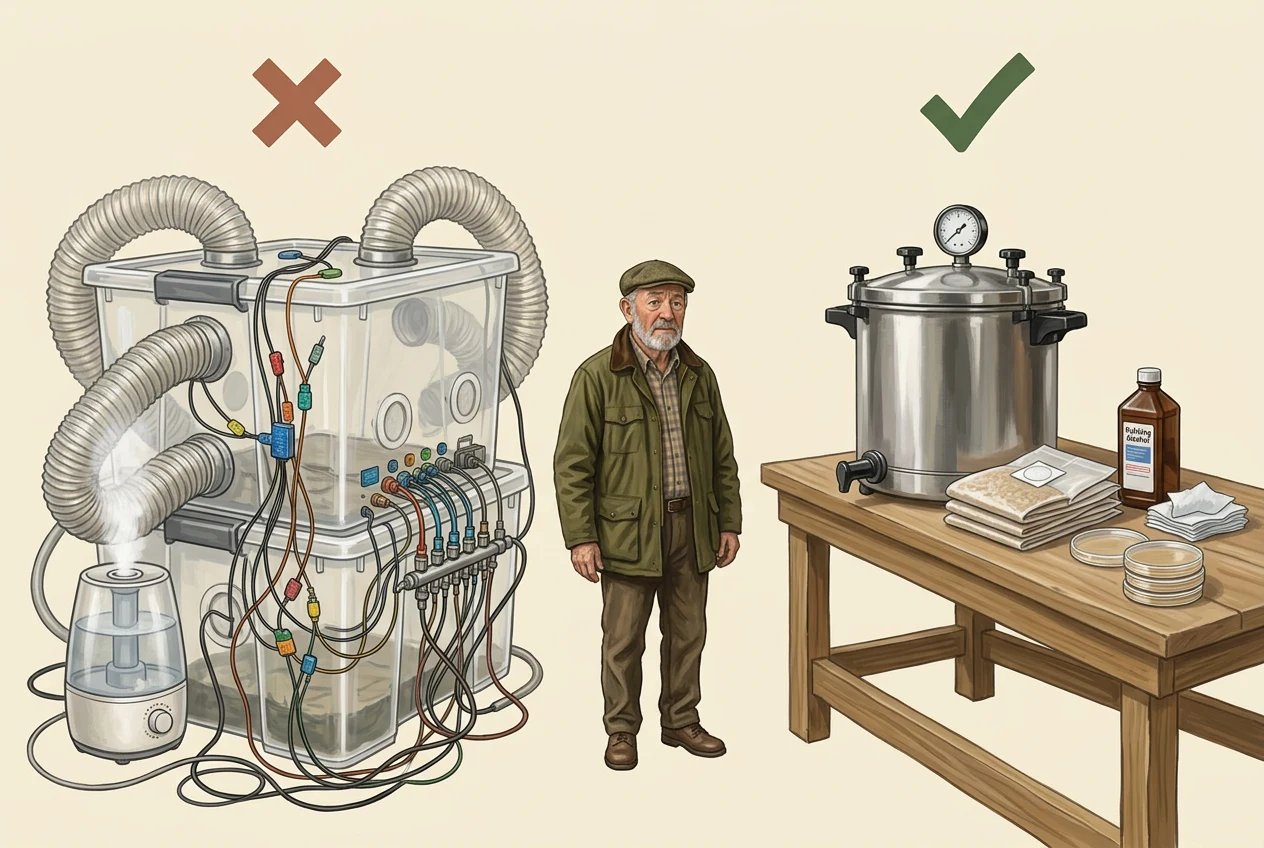
One of the first things beginners seem to discover is the automated fruiting chamber.
Sensors.
Fans.
Humidifiers.
Controllers.
Foggers.
LED lighting.
Tubing.
More sensors.
An app to control the sensors controlling the humidifier controlling the fogger.
Lovely.
Meanwhile, they've got no reliable method of sterilising their grain.
So they've essentially built a £500 climate-controlled hotel for Trichoderma.
The green mould will be delighted.
Temperature controlled. Lovely humidity. Excellent air exchange.
Five stars.
This series is going to start at the other end.
We're going to concentrate first on the boring things.
Clean technique.
Correct hydration.
Proper sterilisation.
Good culture.
Consistent processes.
Unfortunately, none of these have flashing lights.
They do, however, grow mushrooms.
What This Series Is About
This is Uncle Spore's No-Nonsense Beginner's Guide to Growing Mushrooms.
The objective isn't to teach you every possible way of cultivating fungi.
That would be ridiculous.
People have been cultivating mushrooms commercially and experimentally for generations. There are countless species, techniques, substrates, pieces of equipment and variations on each method.
Instead, I'm going to give you one simple foundation.
A process which is:
- relatively inexpensive;
- repeatable;
- controllable;
- suitable for beginners;
- adaptable to several commonly cultivated gourmet mushroom species;
- and simple enough that when something goes wrong, you've half a chance of figuring out why.
That last one is important.
We're deliberately going to reduce the number of variables.
Because if you've changed your grain, substrate, culture, temperature, spawn ratio and fruiting conditions simultaneously and your next grow performs brilliantly, you've learned precisely bugger all.
You know something worked.
You don't know what worked.
This Isn't “The Best Way”
There is an important distinction here.
I'm not claiming that the method in this series is:
THE ULTIMATE SCIENTIFICALLY PERFECT MUSHROOM CULTIVATION TEK™
It isn't.
There are more efficient processes.
There are cheaper processes at scale.
There are techniques better suited to particular species.
There are commercial systems capable of producing enormous yields with extremely tight environmental control.
That's not what we're doing.
We're trying to get somebody who has never grown a mushroom before from:
“What’s mycelium?”
to:
“I’ve just harvested mushrooms that I actually grew myself.”
With the minimum amount of unnecessary faffing in between.
Once you can reliably do that, we can start getting clever.
Bags. We’re Using Bags.
Throughout the main process, we're going to favour filter patch grow bags.
Not because glass jars don't work.
They do.
Not because buckets don't work.
They do.
Not because tubs, bottles and various other containers don't work.
They do.
We're using bags because they provide us with a relatively simple system that can be adapted across grain spawn, bulk substrates and several cultivated mushroom species.
That means you can learn one general workflow without accumulating seventeen different containers and explaining to your partner why the airing cupboard now resembles a microbiology department.
We'll cover the equipment properly in the next parts of the series.
And when I say equipment, I mean equipment you actually need.
Not everything somebody on YouTube has managed to attach an affiliate link to.
No Magic Ingredients
We're also going to keep the recipes deliberately boring.
There'll be no mysterious additives.
No seventeen-ingredient substrate recipes.
No ceremonial splash of this.
No secret teaspoon of that.
No drippy this, super that, mega-growth turbo mushroom potion.
Not because experimentation is bad.
Quite the opposite.
Experimentation is where this gets interesting.
But experimentation is only useful when you've established a baseline.
First we create a process that works.
Then we change it.
Baseline First. Experiment Second.
Suppose you complete your first successful grows.
Brilliant.
Now perhaps you want to know whether:
- changing the grain improves colonisation time;
- increasing the spawn ratio produces faster colonisation;
- a different substrate improves yield;
- supplementation produces larger flushes;
- one culture outperforms another;
- a particular temperature gives better results;
- or that miracle additive somebody on the internet swears by actually does anything.
That's when you experiment.
And this is where Hyphae Fidelity comes in.
The Hyphae Fidelity grow tracker is free to use.
Instead of relying on:
“I'm fairly sure that bag colonised quicker than the other one.”
you can actually record your grows.
Culture.
Grain.
Substrate.
Dates.
Conditions.
Contamination.
Colonisation time.
Harvest.
Yield.
Then change a variable and compare the result.
Keep what improves your process.
Bin what doesn't.
It's considerably more useful than arguing with strangers on Facebook.
- 1Baseline
- 2Record
- 3Change one variable
- 4Compare
- 5Keep what works
What We’re Going to Learn
Over this series we'll work through the cultivation process from the beginning.
We'll look at what fungi actually are and how mushrooms reproduce.
We'll cover the equipment genuinely worth buying.
We'll talk about spores, liquid culture and agar.
We'll learn how to recognise healthy mycelium.
We'll prepare grain spawn.
We'll cover sterile technique and contamination.
We'll prepare substrate.
We'll go from spawn to bulk.
We'll learn what actually triggers fruiting.
We'll look at fresh air, humidity, temperature and light.
We'll harvest.
And then we'll start experimenting.
Nothing particularly exotic.
Nothing unnecessarily complicated.
Just the fundamentals, done properly.
One More Thing: Patience
There is one piece of equipment I cannot give you a link to.
Patience.
Mushrooms don't care that you've taken tomorrow off work.
They don't care that you've got friends coming round.
They don't care that according to the bloke whose video you watched, pins should have appeared on Tuesday afternoon.
Fungi operate on fungal time.
Your job is to give them the correct conditions and then resist the overwhelming human urge to fiddle with everything.
A remarkable amount of mushroom cultivation consists of doing something correctly...
…and then leaving it alone.
This can be surprisingly difficult.
You'll look at the bag.
You'll look at it again.
You'll shine a torch at it.
You'll take seventeen photographs.
You'll post one online and ask whether it's contaminated.
You'll return four minutes later to see whether anything has changed.
It hasn't.
Go and make a cup of tea.
The Uncle Spore Rule
Throughout this series we're going to follow one basic principle:
Keep it clean. Keep it simple. Keep it consistent.
Get the fundamentals right.
Grow some mushrooms.
Record what happened.
Then start changing things.
Because you don't need the best mushroom-growing system in the world to begin with.
You need one that works.
And preferably one that hasn't cost more than the mushrooms you're going to grow in it.
Welcome to the series.
Let's start with something surprisingly few beginners stop to ask:
What the bloody hell is a mushroom, anyway?
While the kettle’s on
- Equipment & Shopping List
- Equipment checklist
- Choose a gourmet species
- Match your species to its substrate
- The detailed grain spawn guide
Keep it clean. Keep it simple. Keep it consistent. Record your baseline, then compare what changes.
Open the grow tracker