
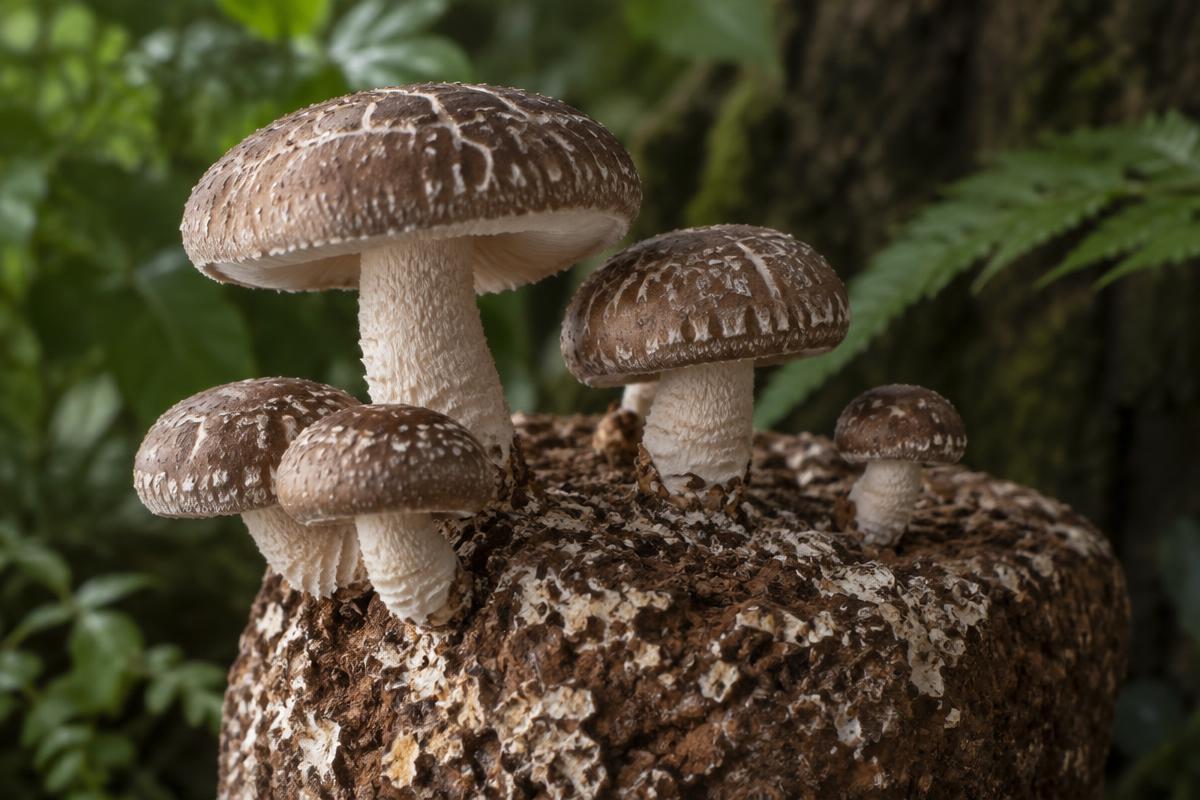
Taste and kitchen use
Deep savoury flavour and firm texture. Remove very tough stems for stock, and cook caps thoroughly. Dried shiitake rehydrate well and become especially aromatic.
Spawn and substrate
Recommended grain spawn
Grain spawn can inoculate indoor blocks; sawdust spawn or wooden dowels are generally preferred for outdoor logs because they fit drilled holes and reduce exposed nutrient pockets.
Best bulk substrate
Sterilised supplemented hardwood sawdust for indoor blocks, or freshly cut healthy hardwood logs for outdoor cultivation. Oak, beech and similar dense hardwoods are traditional choices.
Preparation approach
Indoor blocks require sterilisation and clean inoculation. Allow the white block to blister, brown and firm before removing the bag or initiating. Logs are drilled, inoculated, waxed and kept shaded from drying.
Plan quantities with the spawn-to-substrate ratio calculator and set water using the substrate hydration calculator.
Fruiting environment
Fresh air and CO₂
Moderate fresh air supports well-shaped caps. Stagnation can lengthen stems and encourage blotch, while strong airflow cracks and dries developing caps.
Light and timing
Diffuse daylight or cultivation lighting helps fruiting. Logs belong in a shaded, wind-protected area rather than direct sun.
Approximate indoor block: 6–12 weeks for colonisation and maturation, then around 7–14 days from initiation to harvest. Logs commonly take 6–18 months for a first crop and vary with wood, climate and strain.
Estimate room exchange with the fruiting air-exchange calculator.
Container and method choices
- Sterilised supplemented sawdust block
- Outdoor hardwood log with dowel spawn
- Sawdust-spawned log or totem
Step-by-step home cultivation
- 1
Match spawn to your method: grain for clean indoor blocks, sawdust or dowels for logs.
- 2
Prepare and inoculate the hardwood substrate using clean technique.
- 3
Let indoor blocks fully colonise, blister, brown and become resilient; keep logs shaded and hydrated through their spawn run.
- 4
Initiate a mature block according to the strain, often with cooling and hydration, then provide humidity and fresh air.
- 5
Harvest when caps have opened substantially but edges remain slightly curled.
Keep cultures closed while colonising, work cleanly, and isolate doubtful grows. Review the beginner's grain spawn guide before making your own spawn.
Common failures and contamination
- Fruiting a pale, immature block commonly produces poor yields or contamination.
- Dry logs can pause for months; water deeply rather than repeatedly wetting only the bark.
- Soft patches, foul odour or vivid mould are not normal browning.
For cautious visual triage, use the mushroom contamination checker. It cannot confirm safety.
Harvest, storage and cooking
Harvest indicators
Twist or cut at the base while caps remain firm and before they flatten fully. Record whether the block was soaked or chilled so later flushes can be compared.
Storage and use
Refrigerate in paper for about a week when very fresh, or slice and dry thoroughly. Cook shiitake; some people develop a rash after undercooked raw shiitake.
Scientific & biotechnology interest
Shiitake contains fibre, protein, beta-glucans and lentinan. Lentinan is studied scientifically, but food and purified clinical preparations are not interchangeable.
UV exposure can increase vitamin D2 in mushrooms. Final levels depend on wavelength, exposure, orientation and storage, so ordinary home-grown caps should not be assigned a precise value.
Shiitake enzymes and hardwood decomposition are studied in fungal biology and food-production research.
Science and health disclaimer
Educational only. Nutrients and studied compounds do not make home-grown shiitake a treatment or substitute for medical care.
Frequently asked questions
References and further reading
Sources support the scientific and safety context; they are not recipes and may discuss extracts or experimental systems unlike whole food.
Related mushroom strains
Plan and track your grow
Use free calculators before inoculation, then keep dates, conditions, observations and harvest weights together in Hyphae Fidelity.