
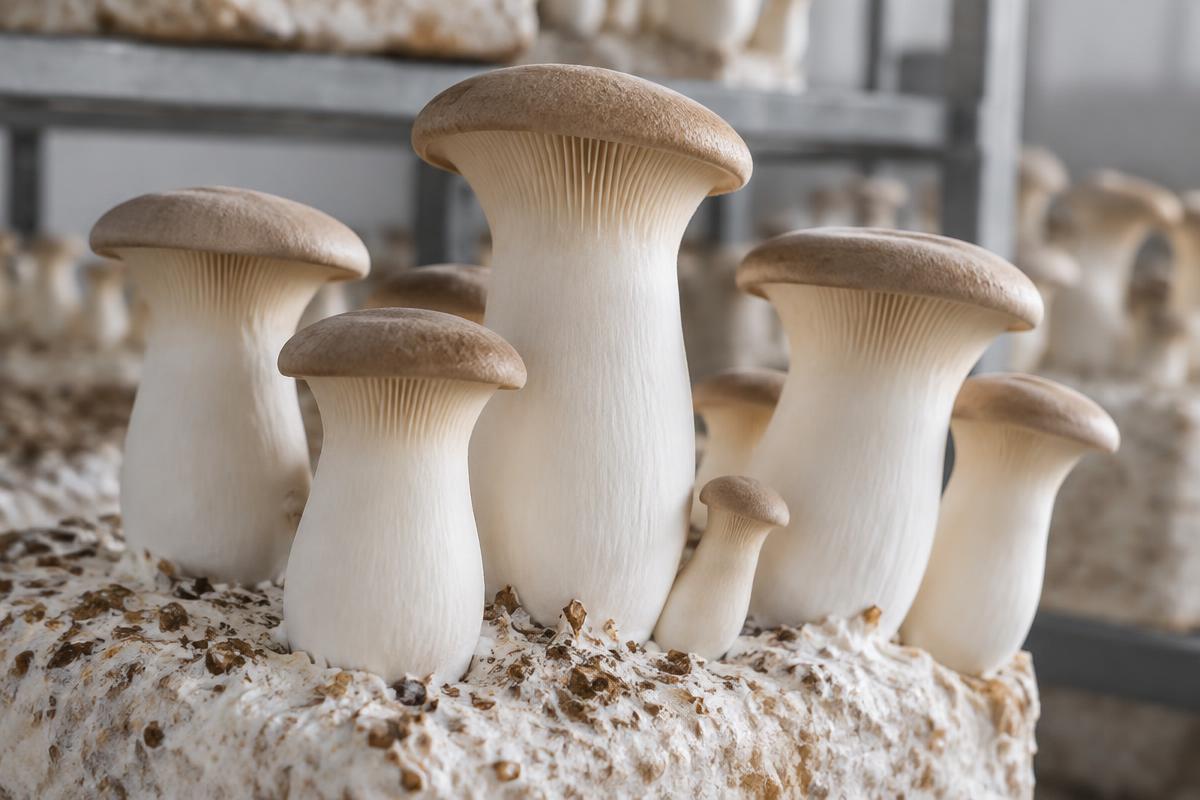
Taste and kitchen use
Firm, savoury and excellent sliced into medallions or scored lengthwise. Cook thoroughly until browned; the substantial stem is the main culinary feature.
Spawn and substrate
Recommended grain spawn
Rye or millet grain spawn is dependable. Millet distributes inoculation points evenly through dense blocks; rye is easy to inspect. Use a moderate, clean spawn rate rather than compensating for weak culture with excess grain.
Best bulk substrate
Sterilised supplemented hardwood sawdust is the standard indoor substrate. Hardwood pellets with bran or soy hull can perform well, but nutrient-rich blocks demand reliable sterile technique.
Preparation approach
Hydrate to a tested target, load a filter-patch bag and sterilise thoroughly. Cool completely before inoculation. Top-fruiting from the bag helps shape individual stems and limits side pins.
Plan quantities with the spawn-to-substrate ratio calculator and set water using the substrate hydration calculator.
Fruiting environment
Fresh air and CO₂
Carbon dioxide influences form: higher levels encourage elongated stems, while more fresh air broadens caps. Extreme restriction produces weak growth, so shape the crop with measured exchange rather than sealing it up.
Light and timing
Provide soft daylight-equivalent light for orientation. Light is a developmental cue, not an energy source; intense light or sun raises drying risk.
Approximate: 14–28 days to colonise and consolidate a hardwood block, followed by 7–14 days from fruiting initiation to harvest. Cold shock is used by some growers but is not essential for every strain.
Estimate room exchange with the fruiting air-exchange calculator.
Container and method choices
- Top-fruited filter-patch block
- Side-fruited supplemented hardwood block
- Bottle culture in a controlled chamber
Step-by-step home cultivation
- 1
Choose vigorous, clean king oyster grain spawn.
- 2
Mix into a sterilised supplemented hardwood block after it has cooled fully.
- 3
Incubate until dense white growth covers the block, then allow brief consolidation if the culture remains wispy.
- 4
Open the top, manage surface moisture and introduce cooler fruiting conditions with controlled fresh air.
- 5
Select healthy pins if overcrowded, then harvest before caps flatten and edges turn upward.
Keep cultures closed while colonising, work cleanly, and isolate doubtful grows. Review the beginner's grain spawn guide before making your own spawn.
Common failures and contamination
- A wet, matted surface can inhibit pinning; avoid spraying the developing mushrooms directly.
- Very wide caps and short stems indicate abundant air, while extreme stretching indicates excessive carbon dioxide.
- Slow, patchy colonisation can reflect wet substrate, weak spawn or bacterial competition.
For cautious visual triage, use the mushroom contamination checker. It cannot confirm safety.
Harvest, storage and cooking
Harvest indicators
Harvest while caps remain slightly convex and stems are firm. Remove the base cleanly to avoid leaving tissue that can decay between flushes.
Storage and use
Refrigerate dry in a paper bag. Their dense texture generally keeps better than delicate oysters, but use promptly if surfaces soften or smell unusual.
Scientific & biotechnology interest
King oyster supplies fibre, protein and fungal polysaccharides; composition depends on substrate and cultivation conditions.
Research has explored polysaccharides and the species as a prebiotic substrate, much of it laboratory or animal work. These findings are not proof of clinical benefit.
Its enzymes and ability to transform plant residues are studied in food biotechnology and circular production systems.
Science and health disclaimer
Educational only. Preclinical findings and food-composition data are not medical advice or evidence that king oyster treats illness.
Frequently asked questions
References and further reading
Sources support the scientific and safety context; they are not recipes and may discuss extracts or experimental systems unlike whole food.
Related mushroom strains
Plan and track your grow
Use free calculators before inoculation, then keep dates, conditions, observations and harvest weights together in Hyphae Fidelity.