
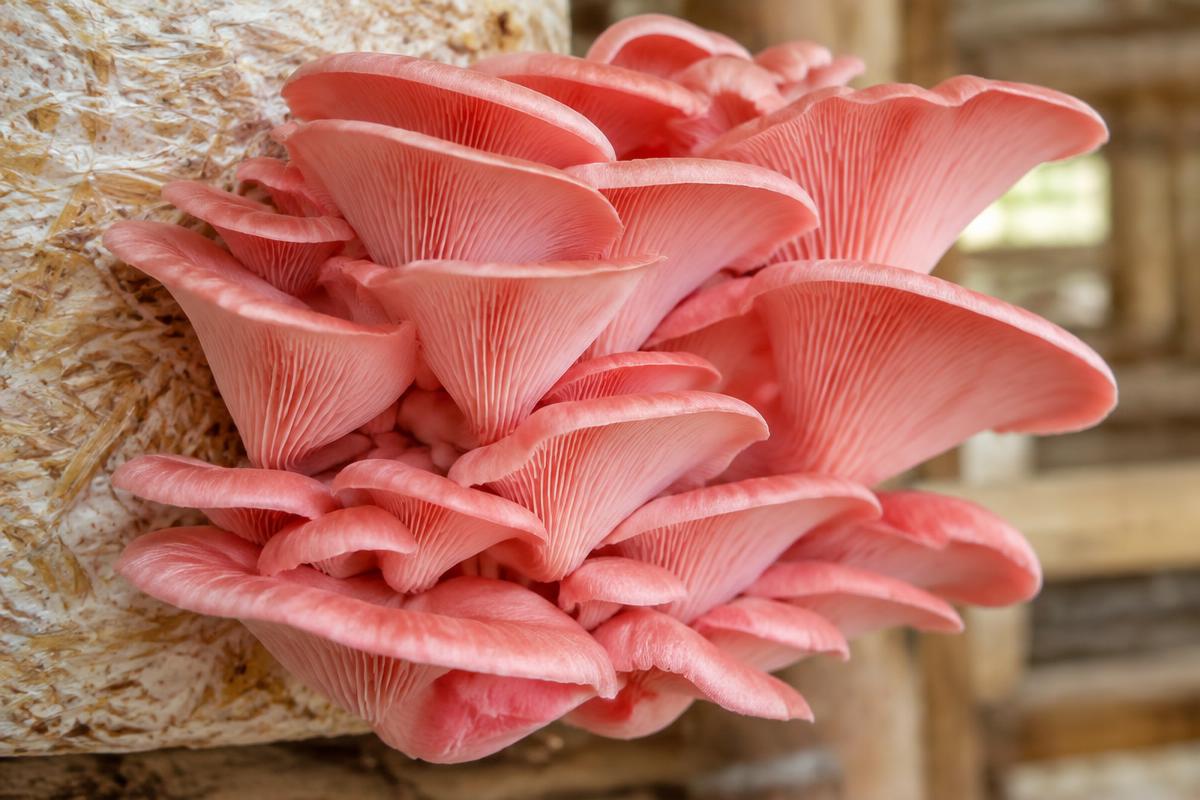
Taste and kitchen use
Best eaten very fresh and cooked thoroughly until edges crisp. The flavour is savoury and stronger than some grey oysters; the bright colour fades with cooking.
Spawn and substrate
Recommended grain spawn
Millet, rye and wheat all work. Warm incubation accelerates mycelium but also favours contaminants, so start with immaculate spawn and avoid overheating the centre of large batches.
Best bulk substrate
Pasteurised straw is economical and fast. Sterilised hardwood sawdust blocks also work, particularly with light supplementation and careful clean technique.
Preparation approach
Pasteurise chopped straw, drain well and layer with spawn in a perforated bucket or bag. Nutrient-supplemented hardwood should be bagged and sterilised, not merely pasteurised.
Plan quantities with the spawn-to-substrate ratio calculator and set water using the substrate hydration calculator.
Fruiting environment
Fresh air and CO₂
Very fresh-air hungry. Dense coral-like growth, long stems or tiny caps are reliable signs that carbon dioxide is accumulating around the fruiting sites.
Light and timing
Diffuse daylight or 8–12 hours of cool-white light supports normal development and colour. Keep the fruiting surface away from hot windows.
Approximate: 7–14 days to colonise a warm straw grow and 3–7 days from pins to harvest. It can stall in cool rooms, while excessive heat increases drying and contamination pressure.
Estimate room exchange with the fruiting air-exchange calculator.
Container and method choices
- Indoor straw bucket
- Filter-patch straw bag
- Hardwood fruiting block
- Warm seasonal grow space
Step-by-step home cultivation
- 1
Confirm the room can remain safely warm without heating the substrate excessively.
- 2
Prepare clean pasteurised straw or a sterilised hardwood block and mix in fully colonised spawn.
- 3
Incubate with filtered gas exchange until the substrate is evenly colonised.
- 4
Open fruiting sites, maintain humid air and provide frequent fresh-air exchange.
- 5
Harvest compact clusters promptly before margins flatten and spores become heavy.
Keep cultures closed while colonising, work cleanly, and isolate doubtful grows. Review the beginner's grain spawn guide before making your own spawn.
Common failures and contamination
- Pale or stretched clusters usually need more fresh air or better light.
- Cool conditions slow or stop this tropical species.
- Over-misting can bruise fruits and leave standing water that encourages bacteria.
For cautious visual triage, use the mushroom contamination checker. It cannot confirm safety.
Harvest, storage and cooking
Harvest indicators
Take the cluster when caps are still strongly coloured and margins remain gently rolled. Pink oysters deteriorate quickly after maturity.
Storage and use
Refrigerate immediately in breathable packaging and aim to cook within two or three days. Never eat raw; cook thoroughly.
Scientific & biotechnology interest
Like other Pleurotus, pink oyster contains fibre, protein, beta-glucans and ergothioneine, with values influenced by substrate and harvest stage.
Antioxidant and metabolic effects are studied in laboratory and animal models. Human evidence is not sufficient for treatment claims.
Its fast growth on straw and other plant residues makes it relevant to research on converting agricultural by-products into food and fungal materials.
Science and health disclaimer
Educational, not medical advice. Laboratory activity does not establish safety, efficacy or a therapeutic dose in people.
Frequently asked questions
References and further reading
Sources support the scientific and safety context; they are not recipes and may discuss extracts or experimental systems unlike whole food.
Related mushroom strains
Plan and track your grow
Use free calculators before inoculation, then keep dates, conditions, observations and harvest weights together in Hyphae Fidelity.