Taste and kitchen use
Mild, nutty and delicate. Cook thoroughly soon after harvest; crisping the edges helps the texture. Mature stems can be tough.
Spawn and substrate
Recommended grain spawn
Millet, rye or wheat grain spawn works well. Fine-grained millet spreads through straw rapidly; larger grains are easier to separate and inspect.
Best bulk substrate
Pasteurised straw and sterilised hardwood sawdust are reliable. Agricultural-residue research uses many materials, but household growers should use known clean, food-safe substrate rather than contaminated waste streams.
Preparation approach
Pasteurise low-nutrient straw and drain to field capacity. Sterilise supplemented hardwood blocks in filter bags and inoculate only after cooling.
Plan quantities with the spawn-to-substrate ratio calculator and set water using the substrate hydration calculator.
Fruiting environment
Fresh air and CO₂
High fresh-air requirement. Carbon dioxide produces elongated stems and small caps; stagnant, saturated air also raises bacterial blotch risk.
Light and timing
Diffuse light for part of each day promotes orientation and normal colour. Avoid direct midday sun and heat buildup.
Approximate: 7–18 days for colonisation and about 4–8 days from pin formation to harvest. Cooler conditions and hardwood blocks can extend these ranges.
Estimate room exchange with the fruiting air-exchange calculator.
Container and method choices
- Straw bucket indoors
- Filter-patch hardwood block
- Seasonal outdoor straw bed
- Perforated fruiting bag
Step-by-step home cultivation
- 1
Use clean, vigorous grain spawn with no coloured patches or sour odour.
- 2
Prepare pasteurised straw or a fully sterilised supplemented hardwood block.
- 3
Mix evenly, close the container and incubate until white growth is complete.
- 4
Expose small fruiting openings to humid air, diffuse light and frequent air exchange.
- 5
Harvest entire clusters while caps remain convex and richly coloured.
Keep cultures closed while colonising, work cleanly, and isolate doubtful grows. Review the beginner's grain spawn guide before making your own spawn.
Common failures and contamination
- Small caps and long stems mean carbon dioxide is too high.
- Thin or cracked caps point to dry air or direct fan exposure.
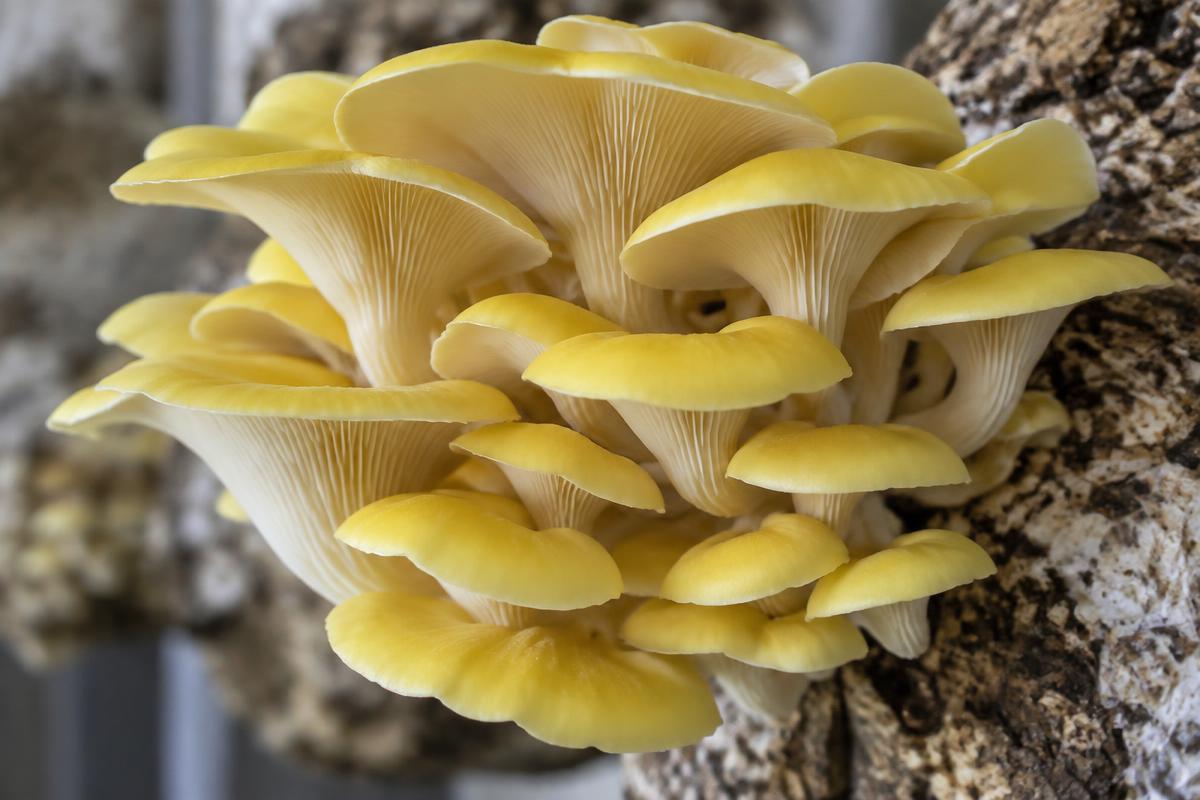
- A yellow cap is normal; green, black or pink growth on the substrate is not.
For cautious visual triage, use the mushroom contamination checker. It cannot confirm safety.
Harvest, storage and cooking
Harvest indicators
Pick before the fragile caps flatten and curl upward. Handle gently because mature clusters bruise and break easily.
Storage and use
Keep dry and refrigerated in paper, generally for only a few days. Cook thoroughly and discard slimy or unpleasant-smelling mushrooms.
Scientific & biotechnology interest
Golden oyster polysaccharides and phenolic compounds are active research topics; much evidence comes from extraction studies, cells or animals.
The species supplies fibre and fungal polysaccharides but composition varies widely with substrate.
Researchers study its lignocellulose-degrading enzymes and ability to grow on agricultural residues, with potential applications in circular cultivation and enzyme production.
Science and health disclaimer
Educational only. Preclinical antioxidant or metabolic findings are not proof that eating the mushroom prevents or treats disease.
Frequently asked questions
References and further reading
Sources support the scientific and safety context; they are not recipes and may discuss extracts or experimental systems unlike whole food.
Related mushroom strains
Plan and track your grow
Use free calculators before inoculation, then keep dates, conditions, observations and harvest weights together in Hyphae Fidelity.