
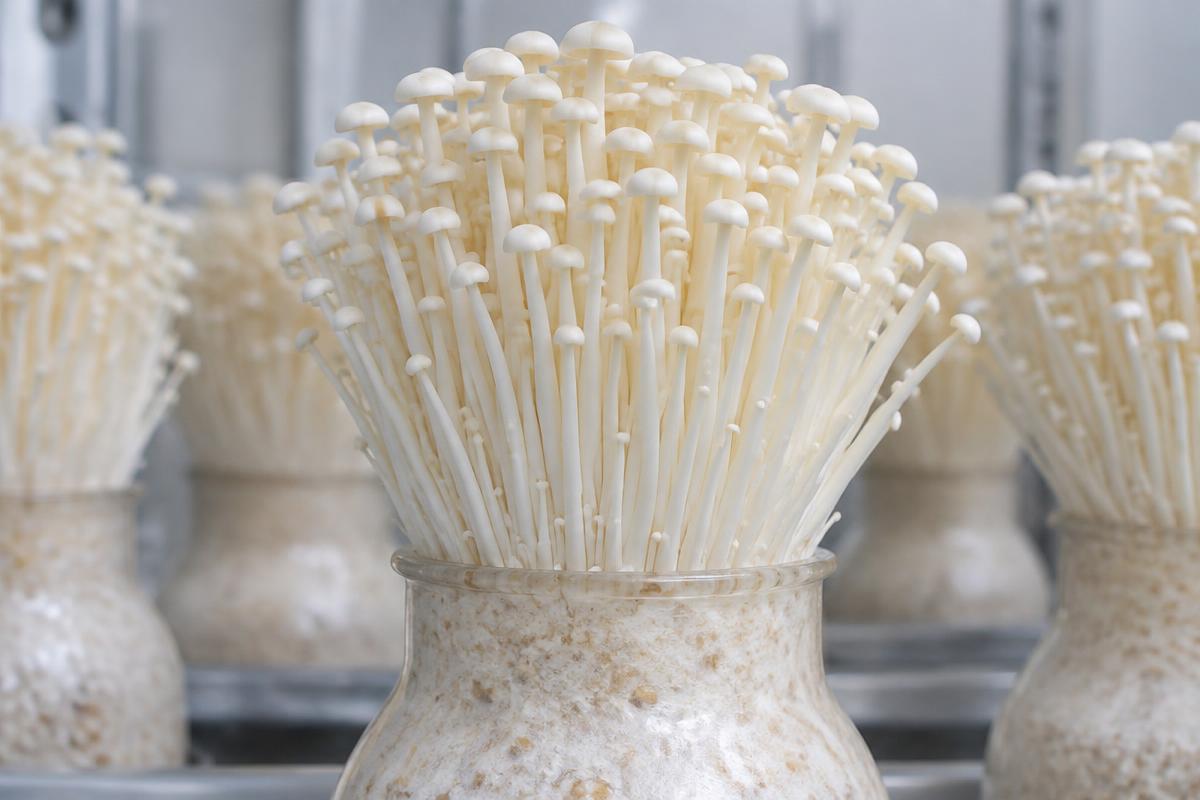
Taste and kitchen use
Delicate with a light crunch when properly cooked. Trim the joined base, separate the stems and cook thoroughly; raw enoki carries a recognised Listeria risk.
Spawn and substrate
Recommended grain spawn
Rye, millet or wheat can inoculate sawdust. Fine grain helps distribute the culture, but the next substrate still needs proper sterilisation.
Best bulk substrate
Sterilised hardwood sawdust, often with modest bran supplementation, in filter bags or heat-safe cultivation bottles. High supplementation raises contamination risk.
Preparation approach
Hydrate and sterilise hardwood substrate, inoculate cleanly, then allow complete colonisation. A controlled cool fruiting space is usually the limiting requirement for home cultivation.
Plan quantities with the spawn-to-substrate ratio calculator and set water using the substrate hydration calculator.
Fruiting environment
Fresh air and CO₂
Commercial long stems are shaped by elevated carbon dioxide, but unsafe stagnation is not the goal. Provide controlled exchange and use a collar only after clean pinning; ordinary fresh-air-grown enoki may have shorter stems and larger, darker caps.
Light and timing
Low light encourages pale commercial form. Natural-looking fruits develop more colour in light. Either form can be legitimate; morphology does not determine food safety.
Approximate: 2–4 weeks to colonise and consolidate, then 2–4 weeks for cool initiation and fruit development. Strain selection strongly affects the temperature requirement.
Estimate room exchange with the fruiting air-exchange calculator.
Container and method choices
- Cultivation bottle with removable collar
- Top-fruited filter-patch bag
- Cool controlled fruiting chamber
Step-by-step home cultivation
- 1
Obtain a cultivated enoki strain suited to your achievable fruiting temperature.
- 2
Sterilise supplemented hardwood substrate in a bottle or filter bag and inoculate cleanly.
- 3
Incubate until fully colonised, then move to the strain's cooler initiation range.
- 4
After pins form, manage a collar, light and air according to the form wanted without creating stagnant, dirty conditions.
- 5
Harvest as a bundle, trim the substrate base, refrigerate immediately and cook thoroughly.
Keep cultures closed while colonising, work cleanly, and isolate doubtful grows. Review the beginner's grain spawn guide before making your own spawn.
Common failures and contamination
- Warm conditions can prevent initiation or produce weak fruits.
- Standing water and stagnant air encourage bacterial problems.
- A darker, wider-capped fruit can be a normal response to light and fresh air, not a failed crop.
For cautious visual triage, use the mushroom contamination checker. It cannot confirm safety.
Harvest, storage and cooking
Harvest indicators
Cut the cluster at the base while stems remain firm and caps small. Move it promptly into a refrigerator at 5°C or below.
Storage and use
UK Food Standards Agency advice highlights Listeria risk in imported enoki. Keep refrigerated at 5°C or below, prevent cross-contamination and cook thoroughly; people at higher risk should be especially cautious.
Scientific & biotechnology interest
Flammulina research examines polysaccharides, phenolics and sterols as functional-food components, with much evidence from laboratory and animal studies.
The difference between wild brown fruit bodies and pale commercial enoki is mainly cultivation environment, not a different legal category.
Cold-fruiting biology and lignocellulose-degrading enzymes are relevant to food biotechnology, but experimental activity is not a health claim.
Science and health disclaimer
Educational only, not medical advice. Food-safety controls matter regardless of proposed functional compounds.
Frequently asked questions
References and further reading
Sources support the scientific and safety context; they are not recipes and may discuss extracts or experimental systems unlike whole food.
Related mushroom strains
Plan and track your grow
Use free calculators before inoculation, then keep dates, conditions, observations and harvest weights together in Hyphae Fidelity.